


Acoustic Insulation: What It Is and How to Solve a Noise Problem

Acoustic insulation refers to the set of techniques, materials, and engineered solutions designed to reduce the transmission of sound waves between different spaces. Its purpose is to prevent noise generated in one environment from penetrating another, ensuring acoustic comfort and compliance with applicable regulations.

Without proper acoustic insulation, a business, machine, or facility is likely to violate current noise regulations. Noise issues are common and have consequences for both human health and business operations.

Types of Noise

Understanding the type of noise involved is essential for selecting and applying the correct solution.

AIRBONE NOISE

Airborne noise is generated by vibrations in the air produced by sound sources and transmitted to adjacent spaces. Sound waves strike a partition—wall, ceiling, or floor—and part of the energy is transmitted through the air to the other side.

Examples: voices, music, or TV sounds coming from a neighboring room.

Effective airborne noise insulation requires:

High‑density, high‑mass materials

Low‑rigidity components

Multilayer systems

Combining materials with different physical properties helps weaken the acoustic wave. 

IMPACT NOISE

Impact noise is transmitted structurally. It occurs when an impact generates a vibration that travels directly through the building’s solid elements.

Examples: footsteps, chair movement, falling objects.

To reduce impact noise, materials capable of absorbing and damping structural vibration must be introduced before it propagates.
 

Why Acoustic Insulation Matters

Many people are unaware of their rights regarding environmental noise levels or that acoustic regulations allow actions to reduce exposure.

Noise and acoustic pollution can affect health in multiple ways: Hearing loss, Stress, Insomnia, Cardiovascular issues, Reduced concentration.

In workplaces, noise can also create legal liabilities for companies.

Regulations define permissible noise levels for emitters during daytime, evening, and nighttime periods at local, regional, national, and international levels. A common misconception is that daytime noise has no limits—it is regulated at all times.
How to Solve a Noise Problem: Professional Process

A noise issue can be resolved effectively only through a technical diagnostic process.

1. Acoustic Assessment and Measurement

Experts visit the facility to evaluate the situation. Using octave‑band and third‑octave‑band measurements, they obtain the noise spectrum and map the problem.

2. Solution Study

With the collected data, the acoustic engineering team develops a calculation model to analyze possible solutions. They identify the most suitable insulation treatments based on:

Noise type, Sound pressure level, Frequency spectrum

3. Budget and Approval

A detailed quotation is presented, ensuring transparency and trust.

4. Installation

Specialized teams install the defined acoustic solutions, which may include:

Absorbing materials, Insulating products, Acoustic barriers, Enclosures and cabins, Acoustic doors, Silencers

5. Acoustic Certification

After installation, final acoustic certification measurements verify compliance with project objectives and regulatory criteria.


Materials and Solutions for Acoustic Insulation

The correct acoustic solution depends on:

  • Noise type
  • Sound level
  • Space characteristics

There is no universal solution; each project requires prior engineering analysis.

Available solutions include:

  • Absorbing materials
  • Insulating products
  • Acoustic barriers
  • Enclosures and cabins
  • Acoustic doors and windows
  • Industrial silencers

When to Consult an Acoustic Specialist

You should consult a specialist if:

  • You experience recurring noise disturbances
  • Your activity may be violating acoustic regulations
  • You need to certify noise levels in a facility

Only a proper engineering diagnosis ensures an effective and durable solution. Acting without it often leads to ineffective investments.

When to Consult an Acoustic Specialist
You should consult a specialist if:
 
You experience recurring noise disturbances
 
Your activity may be violating acoustic regulations
 
You need to certify noise levels in a facility
 
Only a proper engineering diagnosis ensures an effective and durable solution. Acting without it often leads to ineffective investments.
ALL THE INFORMATION IN ONE "CLICK"


ACUSTIART

Absorbers

www.acustiart.com

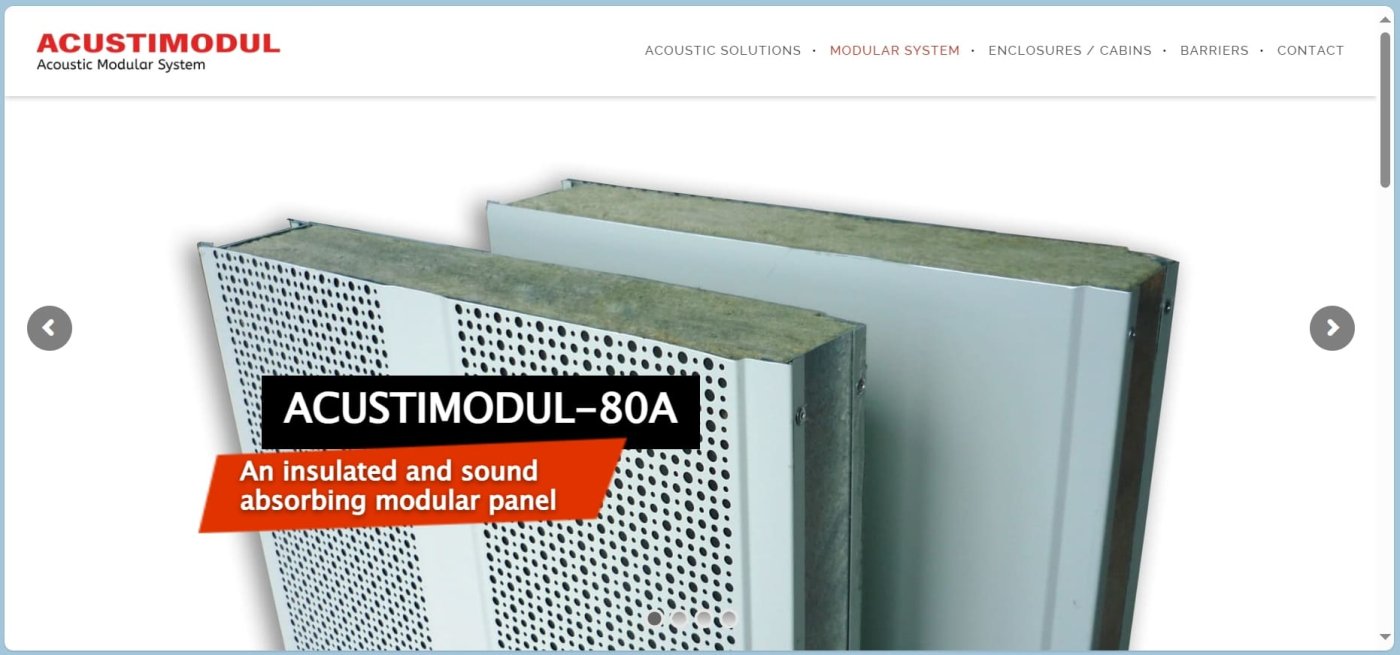
ACUSTIMODUL

Acoustic Barriers and Enclosures

www.acustimodul.com

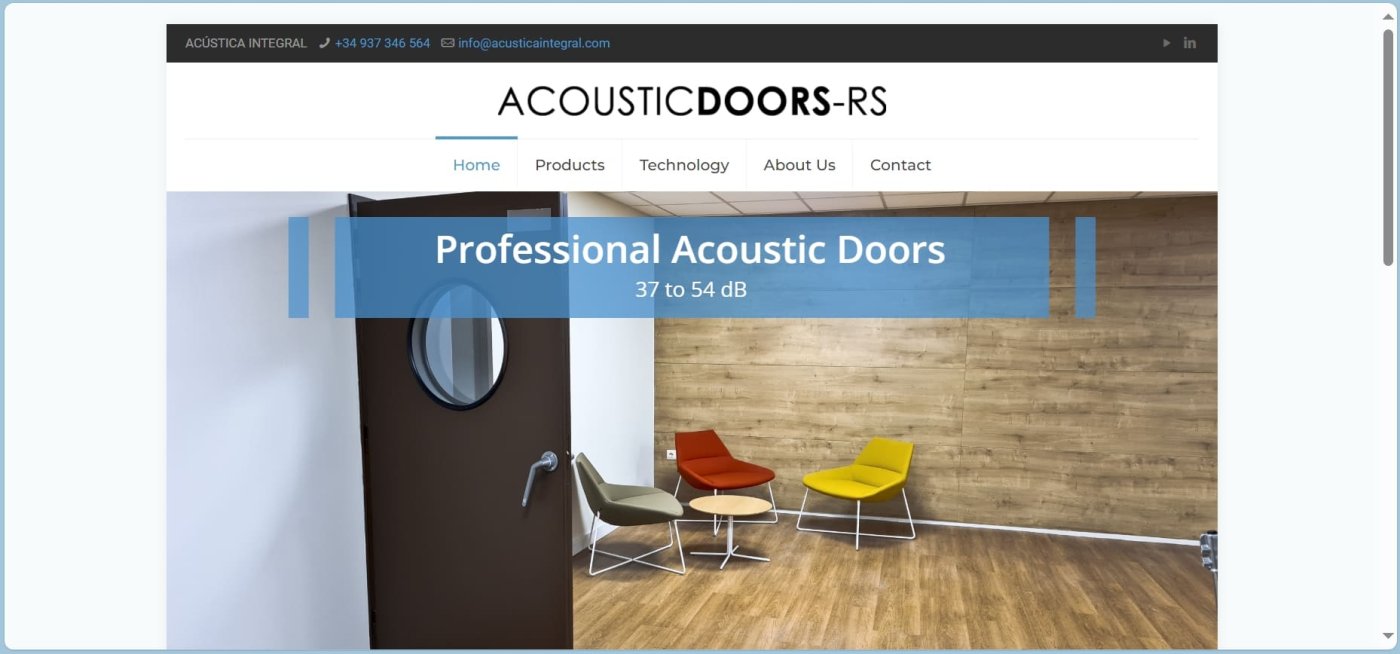
RS DOORS

Acoustic doors 37 to 54 dB

www.acousticdoors-rs.com


Technical cookies are strictly necessary for our website to function and to be able to navigate through it. These types of cookies are those that, for example, allow us to identify you, give you access to certain restricted parts of the page if necessary, or remember different options or services already selected by you, such as your privacy preferences. Therefore, they are activated by default, your authorization is not required in this regard. Through the configuration of your browser, you can block or alert of the presence of this type of cookies, although said blocking will affect the correct functioning of the different functionalities of our website.


The analysis cookies allow us to study the navigation of the users of our website in general (for example, which sections of the page are the most visited, which services are used the most and if they work correctly, etc.). Based on the statistical information on navigation on our website, we can improve both the operation of the page itself and the different services it offers. Therefore, these cookies do not have an advertising purpose, but only serve to make our website work better, adapting to our users in general. By activating them you will contribute to this continuous improvement. You can activate or deactivate these cookies by checking the corresponding box, being deactivated by default.


Functionality cookies allow us to remember your preferences, to customize certain characteristics and general options of our website to your needs, each time you access it (for example, the language in which the information is presented, the sections marked as favorites, your browser type, etc.). Therefore, these types of cookies do not have an advertising purpose, but by activating them you will improve the functionality of the website (for example, adapting to your type of browser) and the personalization of it based on your preferences (for example, presenting the information in the language you have chosen on previous occasions), which will contribute to the ease, usability and comfort of our page during your navigation. You can activate or deactivate these cookies by checking the corresponding box, being deactivated by default.


Advertising cookies allow us to manage the advertising spaces included on our website based on criteria such as the content displayed or the frequency with which the ads are displayed. For example, if you have been shown the same ad on our website several times, and you have not shown personal interest by clicking on it, it will not appear again. In summary, by activating these types of cookies, the advertising displayed on our website will be more useful and diverse, and less repetitive. You can activate or deactivate these cookies by checking the corresponding box, being deactivated by default.


Behavioral advertising cookies allow us to obtain information based on observing your browsing habits and behaviors on the web, in order to be able to show you advertising content that better suits your personal tastes and interests. So that you understand it very simply, we will give you a fictitious example: if your last searches on the web were related to suspense literature, we would show you advertising about suspense books. Therefore, by activating this type of cookies, the advertising that we show you on our website will not be generic, but will be oriented to your searches, tastes and interests, therefore adjusting exclusively to you. You can activate or deactivate these cookies by checking the corresponding box, being deactivated by default.
So that you understand it very simply, we will give you a fictitious example: if your last searches on the web were related to suspense literature, we would show you advertising about suspense books. Therefore, by activating this type of cookies, the advertising that we show you on our website will not be generic, but will be oriented to your searches, tastes and interests, therefore adjusting exclusively to you. You can activate or deactivate these cookies by checking the corresponding box, being deactivated by default.

SAVE

Welcome to the basic information about cookies on the website responsibility of the entity: Acustica Integral SL
We use our own and third-party cookies to analyze our services and show you advertising related to your preferences based on a profile prepared from your browsing habits (for example, pages visited).
You can accept all these cookies by pressing the ACCEPT button or configure them or reject their use by clicking on the COOKIES CONFIGURATION section.
For more information, see the COOKIES POLICY on our website.